
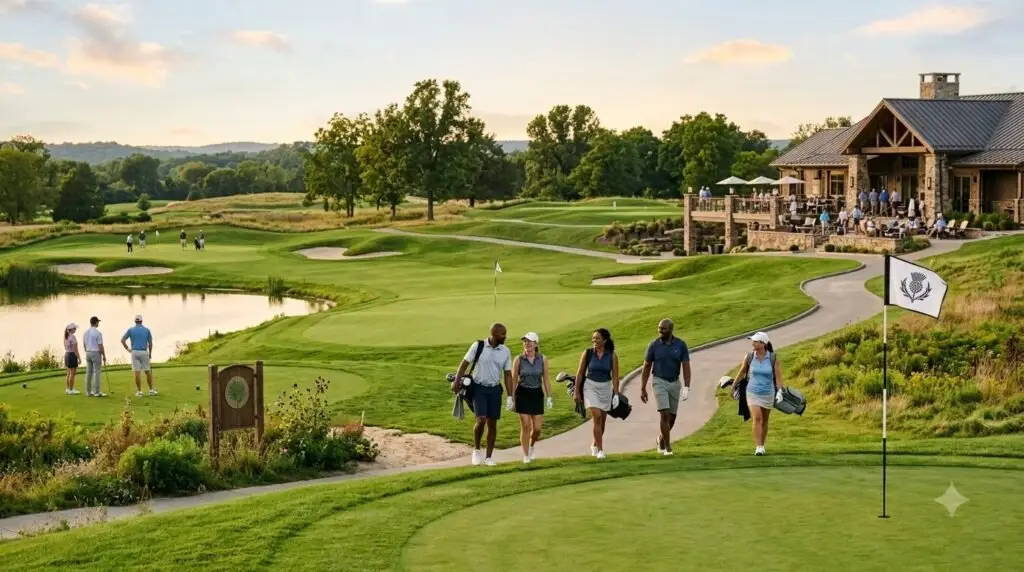
A golf course does not become family-friendly merely because children are allowed through the gate.
The course must make the experience practical for people who are still learning.
That may require:
- Shorter tees
- Manageable round lengths
- Practice facilities
- Patient instruction
- Junior or rental equipment
- Clear pace expectations
- Transparent family pricing
- Safe weather procedures
- Staff who are comfortable helping beginners
Interest in junior golf is significant. The National Golf Foundation reports that just under four million juniors played golf on a course in 2025, the highest total since 2004. Junior participation has increased by 58% since 2019, and girls now represent 35% of junior golfers.
Those numbers do not prove that every family is searching for a golf course. They do show that children and teenagers form a substantial and increasingly diverse part of the game.
For parents, the real question is not:
Does this course welcome families?
It is:
What does the course do to help beginners and children enjoy their first few visits?
What Is a Family-Friendly Golf Course?
A family golf course in Florida is a facility where adults, children, beginners, and experienced golfers can participate without forcing everyone to play the same way.
It may provide:
- Forward or junior tees
- Nine-, 12-, or other shortened rounds
- Par-3 or executive layouts
- Driving range and short-game practice
- Private or group instruction
- Junior equipment
- Walking and riding options
- Family or junior rates
- Beginner-friendly formats
- Food, restrooms, shade, and hydration access
No single feature makes a course family-friendly.
A short course with impatient staff may create a poor first experience. A longer course with appropriate tees, supportive instruction, flexible formats, and clear guidance may work very well.
Why Florida Offers So Many Family Golf Options
Florida has more than 1,200 golf courses, more than any other U.S. state, according to the state’s official tourism organization.
That gives families access to a wide variety of:
- Municipal courses
- Public daily-fee courses
- Resort courses
- Par-3 facilities
- Executive layouts
- Regulation courses
- Short-course concepts
- Practice facilities
Quantity does not guarantee suitability.
Florida families must also plan around:
- Heat
- Humidity
- Lightning
- Seasonal visitor demand
- Daylight
- Course maintenance
- Weekend traffic
The best course is not simply the closest or most famous. It is the one that matches the family’s abilities, schedule, budget, and weather tolerance.
The Features That Matter Most
1. Tees That Match the Player’s Distance
Children and beginners should not automatically play from the same tees as experienced adults.
The USGA defines a good tee fit as one that allows a golfer to reach fairways comfortably, approach most greens with realistic clubs, and experience a useful variety of shots. Its research also emphasizes that many courses need shorter teeing options for golfers with lower swing speeds or shorter hitting distances.
Parents should ask:
- Are junior or forward tees available?
- How long is the course from the shortest tees?
- Are there forced carries?
- Can family members use different tees?
- Does the staff recommend tees by hitting distance?
- Are unofficial family starting points permitted?
Tee selection should be based on ability, not age, gender, colour, or pride.
A child who can reach the green area in a reasonable number of shots has more opportunities to learn putting, strategy, and etiquette. A child facing repeated 400-yard holes mainly learns that golf contains a great deal of walking.
2. A Manageable Number of Holes
A first family outing does not need to contain 18 holes.
Consider:
- Putting only
- Driving range and putting
- Three to six holes
- Nine holes
- A par-3 course
- An executive course
- A 12-hole round
The correct length depends on:
- Age
- Attention span
- Experience
- Heat
- Walking distance
- Course pace
- Whether the child still wants to continue
End the session while the child is still interested.
Finishing every hole has little value when the final hour becomes a slow parade of tired feet, lost balls, and negotiations involving snacks.
3. Practice Before Course Play
A practice facility lets beginners learn basic safety and contact without pressure from a group behind.
Useful facilities include:
- Driving range
- Putting green
- Chipping area
- Practice bunker
- Short practice holes
- Teaching area
Before the first round, practise:
- Where to stand
- When it is safe to swing
- How to hold the club
- Basic putting
- Where to leave equipment
- How to move when another person is playing
- How to identify the group ahead
Paradise Golf Course in Arcadia currently offers a full-length grass driving range, putting and chipping areas, bunker practice, and private or group lessons from PGA and LPGA professionals for different ability levels.
4. Instruction Designed for New Players
A skilled golfer is not automatically a skilled instructor for children.
Ask whether instruction includes:
- Junior or beginner experience
- Age-appropriate communication
- Small group sizes
- Safety
- Basic etiquette
- Games and achievable targets
- Equipment fitting
- Parent participation
- A progression from practice to course play
PGA Jr. League provides team-based golf for different youth age divisions and welcomes a range of skill levels. Local program availability, minimum ages, schedules, and prices vary by facility.
Parents should compare the actual instructor and program rather than assuming that every “junior clinic” offers the same experience.
5. Correctly Sized Equipment
Adult clubs can be too long, heavy, and stiff for a child.
Before buying a complete set, ask whether the course offers:
- Junior rental clubs
- Demo clubs
- Individual putters or wedges
- Lightweight bags
- Pull carts
- Left-handed equipment
Children’s equipment is commonly fitted according to height and strength rather than age alone. U.S. Kids Golf, for example, produces equipment across multiple player-height ranges.
For a first visit, rental or borrowed equipment may be more practical than purchasing a full set.
Confirm availability in advance. “Junior clubs available” may refer to one right-handed set already travelling around the course with another family.
6. Beginner-Friendly Pace Policies
A welcoming course should explain pace without making beginners feel they must sprint.
Helpful beginner formats include:
- Ready golf
- Maximum Score
- Scramble
- Best-ball social play
- Picking up and moving to the green
- Skipping a hole when necessary
The Rules of Golf encourage prompt play and recommend that a stroke generally be made within 40 seconds after the golfer is able to play. Ready golf is encouraged in stroke play when it is safe and responsible.
Maximum Score is an official form of stroke play in which a golfer’s score is capped at a limit established for the round. Once that limit is reached, the player may pick up and continue to the next hole. The USGA specifically identifies the format as useful for beginners and everyday play where pace is a concern.
A simple family rule might be:
After reaching double par, pick up the ball and place it near the green for one chip and two putts.
That keeps the child involved without allowing one difficult hole to swallow the afternoon.
7. Transparent Family Pricing
Do not assume that children play free or that a family membership includes every household member.
Check:
- Adult green fee
- Junior green fee
- Cart fee
- Walking rate
- Rental clubs
- Range balls
- Lesson cost
- Booking fees
- Tax
- Food
- Membership eligibility
- Age limits
- Blackout times
Use:
Total family golf cost =
Adult fees
+ junior fees
+ carts or walking fees
+ rentals
+ range balls
+ instruction
+ taxes and booking fees
+ food and drinks
Paradise Golf Course currently publishes public, walking, and all-you-can-play rates as well as seasonal and annual family memberships. Exact household eligibility, age limits, benefits, and current prices should be confirmed directly before joining.
A family rate provides value only when the family can realistically use it.
8. Flexible Round Formats
Families benefit when the course does not force every visit into one structure.
Paradise Golf Course uses a regulation 12-hole layout and currently allows golfers to play 12, 18, or 24 holes. The facility promotes the core 12-hole round as a less-than-three-hour option under suitable playing conditions.
That type of flexibility may help families choose according to:
- Available time
- Weather
- Children’s energy
- Experience
- Plans after golf
A flexible format does not guarantee a fast round. Group size, traffic, course conditions, and player behaviour still matter.
9. Practical Facilities for Families
Parents should also inspect the less glamorous parts of the experience.
Check for:
- Restrooms
- Drinking water
- Food or snacks
- Shade
- Seating
- Parking
- Changing facilities
- Cart rules
- Accessibility
- Emergency shelter
- First-aid procedures
A beautiful golf course becomes considerably less enchanting when the nearest restroom is five holes away and someone announced a bathroom emergency on the second tee.
Florida Heat and Lightning Safety
Weather should influence when and how long a family plays.
Heat
During dangerous heat conditions, the National Weather Service recommends considering postponing or rescheduling outdoor activity, drinking water, taking breaks in the shade, and avoiding the hottest portion of the day.
For children and beginners:
- Check the hourly forecast and heat alerts
- Select an earlier time when appropriate
- Carry water
- Use sunscreen and hats
- Take breaks
- Shorten the round when fatigue appears
- Do not leave a child in a parked vehicle
Do not use a prepaid green fee as a reason to continue when someone appears unwell.
Lightning
The National Weather Service advises outdoor sports organizers and participants to seek proper shelter when thunder is heard. Safe shelter generally means a fully enclosed building or a hard-topped metal vehicle. Golf carts, covered patios, pavilions, and isolated trees are not adequate shelter.
Remain sheltered until 30 minutes after the last thunder.
Before playing, ask:
- How does the course issue lightning warnings?
- Where should families shelter?
- Who stops play?
- What is the rain-check policy?
- How will a child be reunited with a parent during an organised program?
How Parents Should Plan the First Visit
Step 1: Call the Course
Ask:
- Do you welcome first-time junior golfers?
- What is the shortest available round?
- Which tees should we use?
- Are junior rentals available?
- Is walking permitted?
- What is the expected pace?
- Are lessons available?
- Is there a quiet time you recommend?
- What is the weather policy?
Step 2: Begin at the Practice Area
Spend the first visit learning:
- Safe swinging
- Putting
- Basic contact
- How to carry or place clubs
- One or two simple etiquette rules
The child does not need twelve swing thoughts. “Stand safely, aim there, and have fun” is a respectable opening syllabus.
Step 3: Use a Short Format
Start with three to nine holes, a par-3 course, or a structured short round.
Create simple goals such as:
- Make contact
- Reach the green
- Two-putt one hole
- Repair one ball mark
- Rake one bunker
- Keep pace with the group
Step 4: Stop Before Exhaustion
Watch for:
- Loss of attention
- Repeated unsafe movement
- Irritability
- Heat discomfort
- Hunger
- Loss of interest
Leaving early is not failure. It is often excellent customer-retention strategy for the child.
Step 5: Let the Child Decide What Comes Next
Ask:
- What part was most fun?
- Would you rather putt, practise, or play next time?
- Was the course too long?
- Did the lesson help?
- Do you want to return?
The goal is to discover whether the child enjoys golf, not to draft a ten-year tournament schedule after one successful putt.
What Families Should Avoid
Booking the longest course available
Better approach: Choose tees and a round length that match the shortest hitter.
Starting during extreme heat
Better approach: Use the hourly forecast and adjust the plan.
Assuming early morning is always quiet
Maintenance, leagues, events, and strong demand can make early times busy.
Better approach: Ask the golf shop for a suitable beginner window.
Keeping strict stroke-play scores
One difficult hole can become a slow mathematics seminar.
Better approach: Use Maximum Score, scramble, or informal play.
Buying expensive equipment immediately
Children grow and interests change.
Better approach: Rent, borrow, or begin with a few correctly fitted clubs.
Coaching every shot
Constant correction can make the outing feel like an examination.
Better approach: Limit instruction and celebrate effort, safety, and good decisions.
Promising that children will love golf
Some will. Some will prefer the putting green. Others will display a passionate interest in the snack counter.
Better approach: Treat the first visits as exploration.
How to Compare Florida Family Golf Courses
Use this scorecard:
| Category | Questions to ask |
| Course fit | Are shorter tees and manageable holes available? |
| Round length | Can we play fewer than 18 holes? |
| Practice | Are putting, range and short-game areas available? |
| Instruction | Are beginner and junior lessons offered? |
| Equipment | Can children rent suitable clubs? |
| Pace | Are beginner formats and suitable times available? |
| Cost | What is the complete family price? |
| Weather | Is there safe lightning shelter and a clear policy? |
| Facilities | Are restrooms, shade, water and food accessible? |
| Atmosphere | Do staff help newcomers without making them feel unwelcome? |
A course does not need to receive a perfect score in every category. It should perform strongly in the areas most important to the household.
Is Paradise Golf Course a Practical Family Option?
Paradise Golf Course in Arcadia may suit families seeking a flexible public golf experience rather than a conventional 18-hole-only visit.
Its currently verified features include:
- A regulation 12-hole layout
- Options to play 12, 18, or 24 holes
- Walking and cart access
- Public play
- A full-length grass driving range
- Putting, chipping, and bunker practice
- PGA and LPGA instruction for different skill levels
- Club and pull-cart rentals
- Seasonal and annual family memberships
- On-site dining
The course may be a strong fit when:
- The family wants more than nine but fewer than 18 holes
- Beginners want to practise before playing
- Parents prefer a public facility
- Walking is important
- Golf is one part of a wider day
- The household expects to use a family membership regularly
Families should still verify:
- Junior age policies
- Current family-membership eligibility
- Junior rental availability
- Lesson pricing
- Tee recommendations
- Pace expectations
- Weather procedures
- Current food-service hours
The presence of a family membership does not automatically confirm that every children’s program or junior benefit is included.
Frequently Asked Questions
What makes a golf course family-friendly?
A family-friendly course offers suitable tees, manageable round lengths, beginner instruction, practice facilities, transparent pricing, safe operating procedures, and staff who are comfortable helping new players.
What age can children start playing golf?
There is no universal starting age. Readiness depends on the child’s interest, attention, ability to follow safety instructions, and access to suitable equipment. Individual courses and programs may set minimum ages.
Are par-3 courses good for children?
They can be. Shorter holes often make it easier for beginners to reach greens and remain involved. Difficulty still depends on hazards, walking conditions, and tee placement.
Should a child begin with 18 holes?
Usually not. Begin with putting, practice, several holes, nine holes, or another short format and increase the length only when the child remains comfortable.
How can beginners maintain pace?
Use appropriate tees, ready golf, Maximum Score, short ball searches, and a scramble or other flexible format.
Do Florida courses offer junior discounts?
Some do, but policies vary. Confirm age limits, eligible times, carts, equipment, taxes, and whether an adult purchase is required.
What should a family bring?
Bring water, sunscreen, hats, comfortable clothing, suitable shoes, snacks, extra balls, and correctly fitted clubs or confirmed rentals.
Are family golf memberships always economical?
No. Compare the complete membership cost with how often the household will play, practise, dine, or use other benefits.
Does Paradise Golf Course offer lessons?
Its current practice page lists private and group instruction from PGA and LPGA professionals for different skill levels.
Can families play fewer than 18 holes at Paradise?
Yes. The course currently offers 12-, 18-, and 24-hole playing options.
Final Takeaway
Families are not simply looking for golf courses that allow children.
They are looking for courses that remove unnecessary barriers.
The strongest family golf experience provides:
- Suitable distances
- Flexible round lengths
- Beginner instruction
- Practice before play
- Appropriate equipment
- Clear pace guidance
- Transparent pricing
- Heat and lightning planning
- A genuinely welcoming atmosphere
Parents should begin small, choose tees according to hitting distance, use flexible scoring, and stop before fatigue replaces curiosity.
Golf does not need to become easier to welcome families. It needs to become easier to enter.
Plan a Family Golf Visit in Florida
Before reserving a tee time, contact the course and confirm:
- Junior policy
- Round length
- Tee options
- Club rentals
- Practice access
- Instruction
- Complete price
- Weather procedures
Paradise Golf Course provides one Florida example of flexible golf through its regulation 12-hole layout, practice facilities, instruction, rentals, public access, and family membership options.
The first family golf outing does not need a perfect scorecard.
It needs a safe swing, one satisfying shot, enough snacks, and a reason to return.